Editorial explainer · official sourceshigh
How to break the ransomware-as-a-service model: what the official sources actually say
Ransomware today is a service industry, not a lone wolf: operators who rent the malware, affiliates who strike, brokers who sell the initial access. This explainer is not the attack of the day: it lines up what official sources say — CISA with #StopRansomware, Europol with the No More Ransom project, ENISA with its Threat Landscape — on how that chain breaks. The takeaway is less spectacular than a ransom and more useful: you hit the model's economics, not the single group.

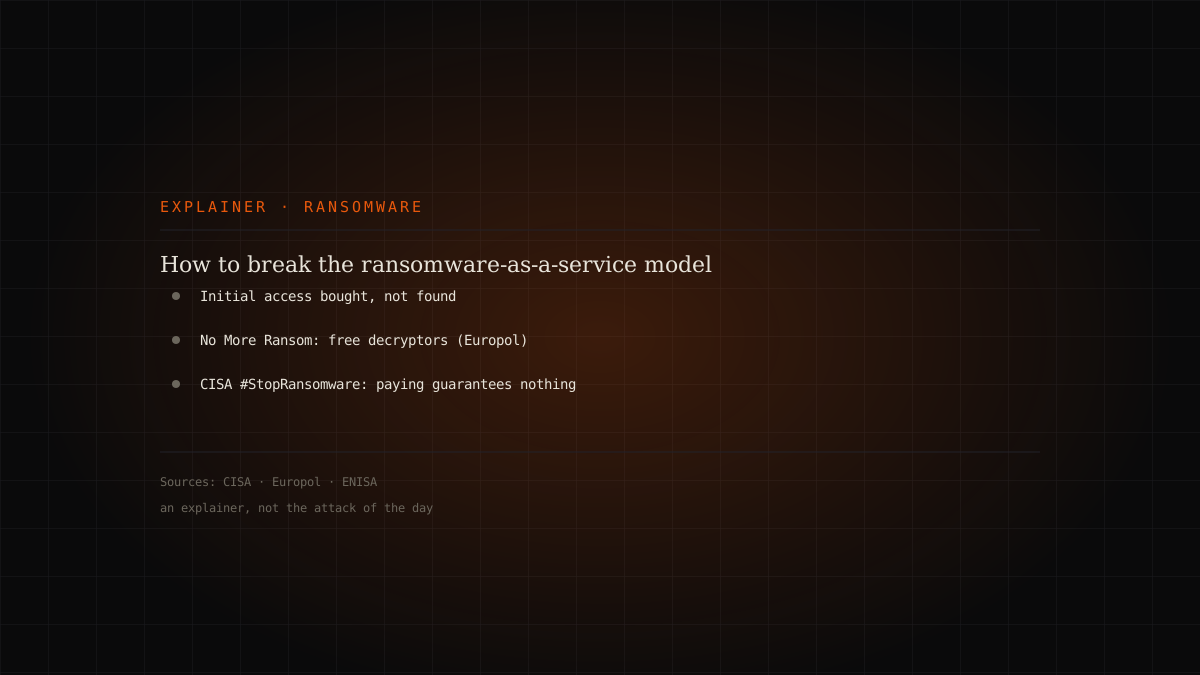
An explainer, not the attack of the day
We publish dossiers on individual ransomware attacks when there is verified material. This piece is a different thing: a step back to look at the model. Because effective defense does not come from reacting to the group of the day, but from understanding how the industry that produces it works — and what, per the agencies, actually weakens it.
Not a lone wolf, but a supply chain
Modern ransomware is organized as a service economy. Operators develop and maintain the malware and the extortion infrastructure, and rent it; affiliates run the intrusions and split the ransom; upstream, initial access brokers sell ready-made access to compromised networks. This is the Ransomware-as-a-Service (RaaS) model, and its practical consequence is that most attacks do not start with an exotic technique: they start with bought access — a stolen credential, an exposed service, an unpatched VPN.
To this was added double extortion: before encrypting, attackers exfiltrate the data and threaten to publish it. So the backup, which once was enough to say "no" to a ransom, no longer resolves the reputational and legal side on its own. It is one of the reasons ENISA, in its annual Threat Landscape, consistently places ransomware among the prime threats in the Union.
- 01Initial accesscredentials or exposed services, often bought from a broker
- 02Movement and data theftrecon, escalation, exfiltration before encryption
- 03Double extortionencryption + threat to publish the data
- 04Ransompaid in cryptocurrency, with no guarantee of recovery
What the official sources say about breaking it
Here the agencies converge, and it is worth reporting them without embellishment.
Paying guarantees nothing. The #StopRansomware guidance from CISA and the FBI discourages payment: it does not ensure data recovery, does not stop publication of what was already stolen, and funds the next attack. The decision remains the victim's, but it should be made knowing that a ransom buys a promise, not a result.
Sometimes the decryptor already exists, for free. The No More Ransom project, coordinated by Europol together with law enforcement and security firms, collects free decryption tools for many ransomware families. Before considering any payment, the first check is whether a public key already exists for that specific variant.
Defense is known and boring, and it is what works. The StopRansomware Guide lines up the measures that really reduce risk: offline, tested backups; timely patching (starting with internet-facing services); phishing-resistant multi-factor authentication; network segmentation; least privilege; and an incident-response plan rehearsed before it is needed.
The point that holds the picture together
If the model is an economy, you hit it where it is economically vulnerable: by raising the cost of initial access (patching, MFA, closing exposures), reducing the value of stolen data (segmentation, encryption, minimization), and taking away the payment leverage (backups that let you say no, and the check on No More Ransom). None of these is spectacular, and that is exactly why they work: they do not chase the latest name on the scene, they erode the conditions that make ransomware a business. For operational detail and updates, the references remain CISA #StopRansomware, Europol's No More Ransom portal and ENISA's Threat Landscape — the sources this explainer is drawn from.