Editorial explainer · official sourcesmedium
The human factor is not the weak link: why blame doesn't stop phishing
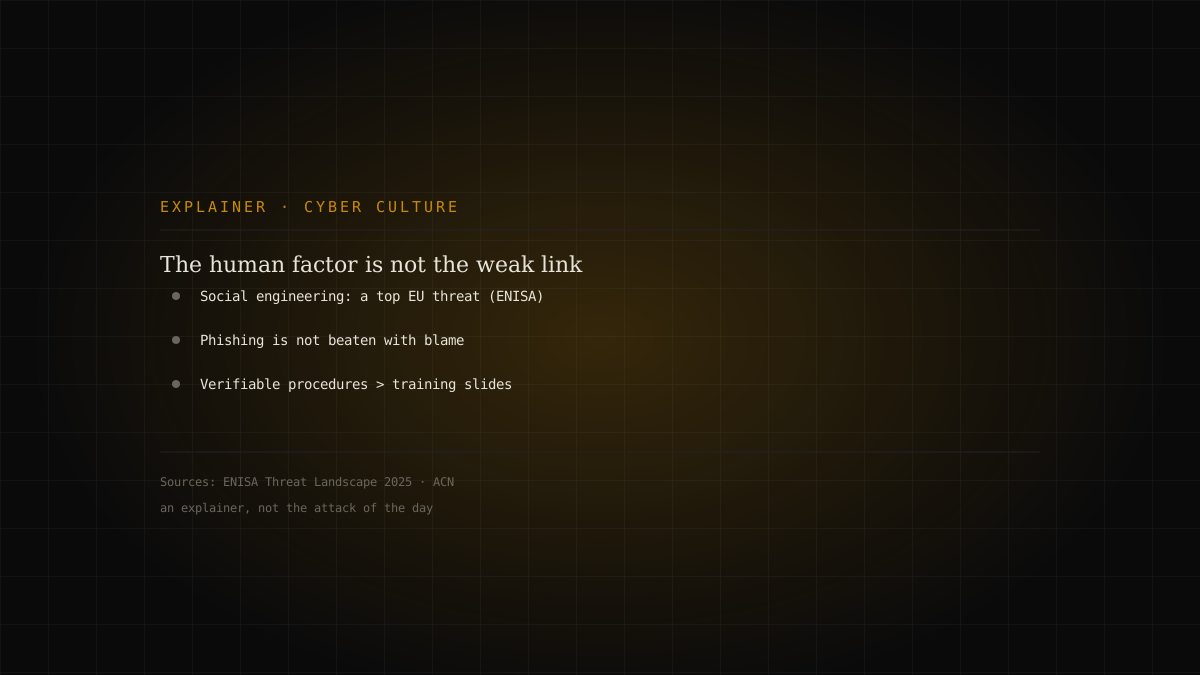
Social engineering is among the prime threats in the Union according to ENISA, yet the most common reaction stays the worst: blame whoever clicked. This explainer explains why the "human factor" is not a weak link to scold but a system to design — with verifiable procedures, blame-free reporting and tools that make the deception ineffective. Not the attack of the day, but the culture that decides whether the technical defenses hold.

An explainer, not the attack of the day
In our dossiers social engineering keeps returning: the QR code that steals the session, the fake "I'm not a robot" check that makes you paste a command, the technician impersonated on the phone. It is the moment the attack stops being technical and becomes human. It is worth pausing on that moment, because that is where the part of security no patch covers is decided.
A prime threat, not a footnote
ENISA, the Union's cybersecurity agency, in its annual Threat Landscape consistently places social engineering among the main threats in Europe. It is not a garnish: it is one of the most frequent ways attackers get the first access, because it bypasses perimeter defenses by hitting a person's decision — to click, open, authorize, call back.
Phishing and its variants work not because people are stupid, but because they are designed to exploit how we actually function: haste, authority, trust, context. A message that seems to come from the boss, at a busy moment, with a plausible request, beats anyone's theoretical awareness sooner or later.
Why blame is the wrong reaction
The instinctive response after a bad click is to find the culprit. It is counterproductive for a precise reason: a blame culture teaches people to hide mistakes, not to report them. And in phishing defense the speed of reporting is everything — an employee who warns ten minutes after clicking allows containment; one who stays silent for fear of punishment hands the attacker precious hours.
- 01Click or actionthe deception works: it happens, even to the prepared
- 02Fast reportingpossible only if there is no fear of punishment
- 03Containmentcredential reset, isolation, analysis — before it spreads
- 04Learningfix the process, don't hunt the culprit
What actually works, per common sense and the agencies
The message emerging from ENISA's and ACN's awareness materials is that people's security is designed, not preached. Three practical principles are worth more than a slide.
First: make the deception ineffective, not just recognizable. Phishing-resistant multi-factor authentication ensures a stolen credential is not enough; it is a defense that does not depend on the person never erring. Second: verifiable procedures for sensitive requests — a transfer, a change of bank details, a reset — with an independent confirmation channel, so that "the boss asked me by email" is not enough to act. Third: easy, blame-free reporting, a button or address everyone knows, and the explicit promise that whoever reports is not punished.
The point
"The human factor is the weak link" is a convenient phrase because it offloads responsibility onto the person and absolves the system. But a link known to be fragile is reinforced by design, not by reproach. Cyber culture is not convincing people never to err: it is building an environment where a single mistake does not become a breach, and where whoever makes it finds it more convenient to say so at once than to hide it. To go deeper, ENISA's and ACN's materials are the starting point this article is drawn from.